NewMusic

 TRACK
Sound
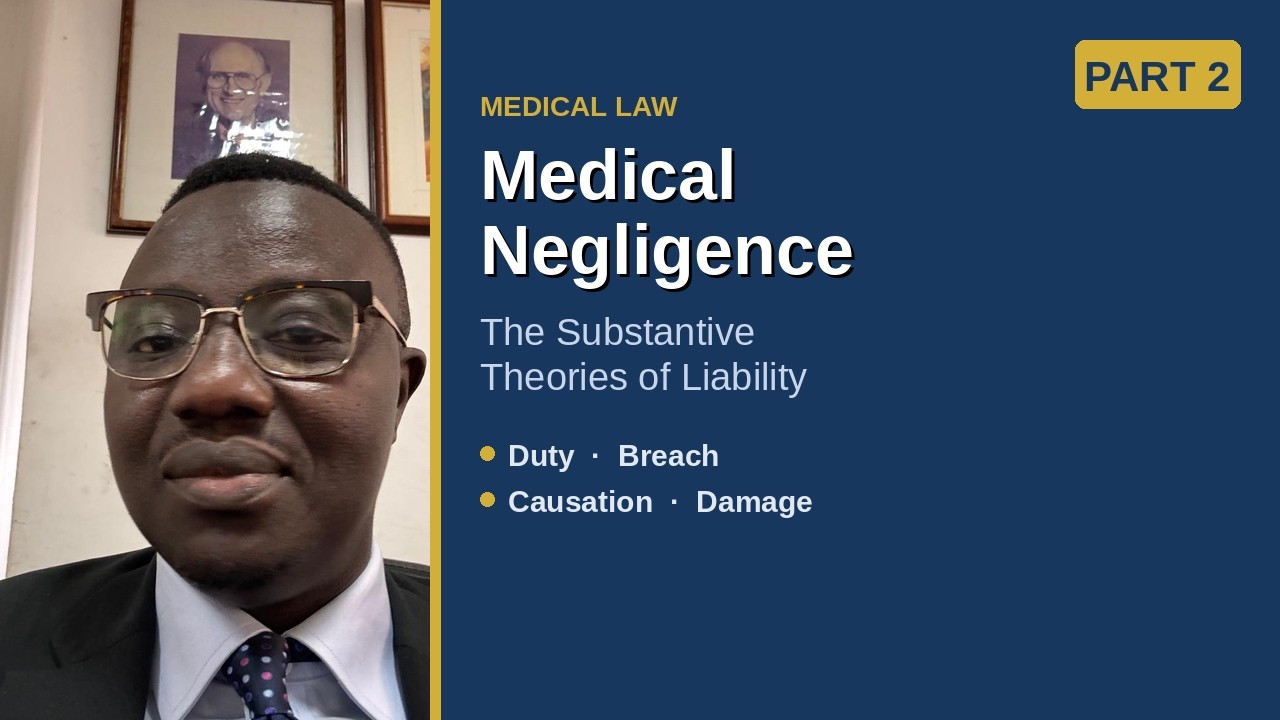
MEDICAL NEGLIGENCE The Substantive Theories of Liability ( Part 2)
Moe Ghandour
2:22:55 duration0 plays0 favoritesMedium quality
Play now
About this track
Medical Negligence — Lecture 2b: The Substantive Theories of Liability (Part 2) This lecture examines the doctrinal foundations of medical liability, focusing on negligence as the primary theory and battery as the older protector of bodily integrity, with sustained attention to the Ghanaian authorities. NEGLIGENCE: THE PRIMARY THEORY The law imposes not perfection but reasonable competence. Liability turns on four cumulative elements — duty, breach, causation, and damage — and failure on any one defeats the claim (Ghana Highway Authority v Mensah). Duty of Care. A duty is an obligation to take reasonable care to avoid foreseeable harm. Its modern foundation is Lord Atkin's neighbour principle in Donoghue v Stevenson (1932), expressly applied in Ghana (Chinbuah v A-G). Duty is not automatic: proximity must exist, and the court asks whether it is just and reasonable to impose it (Edward Nasser & Co v McVroom). Doctors owe duties on undertaking diagnosis, advice or treatment; hospitals are independent duty-bearers for staffing, systems and patient safety (Cassidy v Ministry of Health; Asante Kramo v A-G). Duty is expanding toward unborn children, relatives, third parties and future patients, though courts remain cautious where unlimited liability or confidentiality arises. Breach. The benchmark is professional practice: a doctor is not negligent if acting in accordance with a responsible body of medical opinion (Bolam v Friern Hospital). The Ghanaian formulation asks whether the doctor failed as no doctor of ordinary skill would, adopting Hunter v Hanley and Whitehouse v Jordan — a wrong diagnosis is not negligence per se (Gyan v Ashanti Goldfields; Dr Sandys Arthur). Bolitho v City & Hackney HA restored judicial oversight: courts may reject expert opinion that is illogical or irrational. Montgomery v Lanarkshire HB shifted disclosure from paternalism to autonomy, requiring doctors to disclose material risks judged by what a reasonable patient would consider significant. Causation. The breach must actually cause the
From the album
 GHANA LAW TV30 tracks · Track 27
THIS CHANNEL FOUNDED BY DR. ERNEST OWUSU-DAPAA ( DEAN , Faculty Of Law, KNUST 1st January 2022– 31s...
→You may also like