NewMusic

 TRACK
Sound
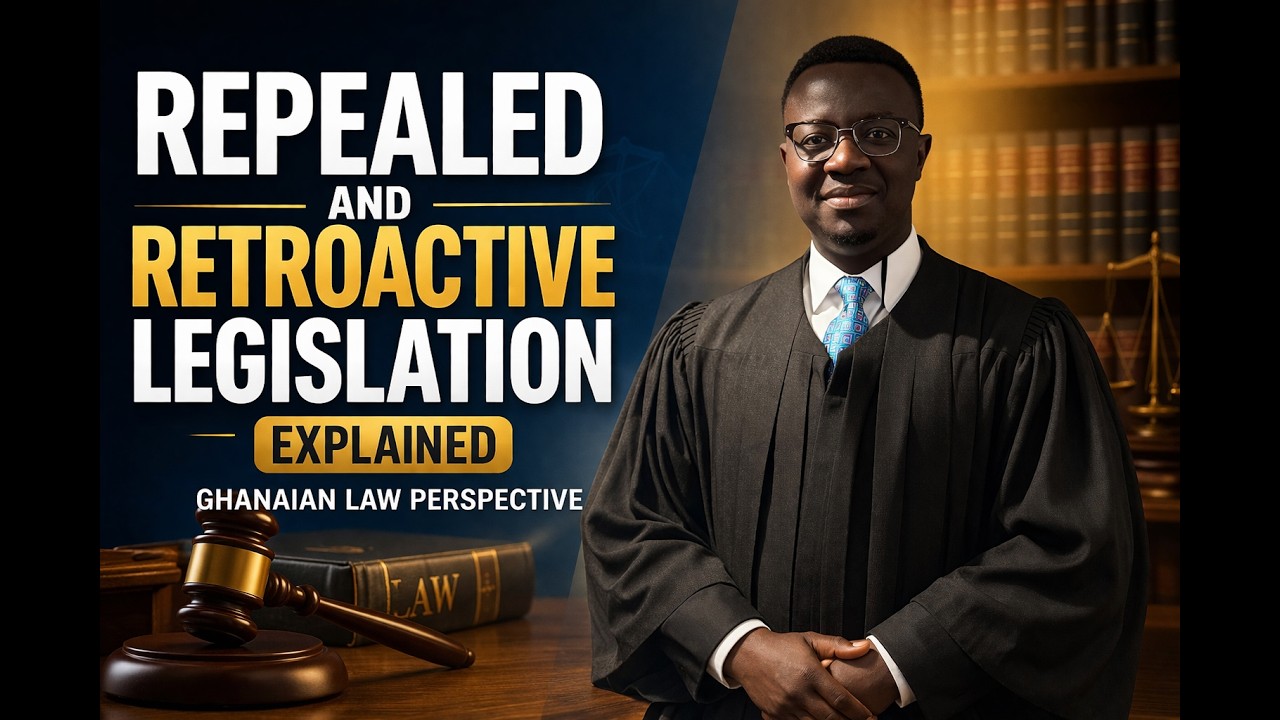
REPEALED AND RETROACTIVE LEGISLATION
Moe Ghandour
2:12:20 duration349 plays0 favoritesMedium quality
Play now
About this track
Repealed and Retrospective Legislation in Ghanaian Law In this lecture, I examine the doctrines of repeal and retrospectivity, which lie at the heart of statutory and constitutional interpretation. These doctrines operate at the intersection of legislative power, legal certainty, and the protection of vested rights. The central question is this: to what extent can a change in law affect rights, obligations, or proceedings that already exist? This issue arises where statutes are repealed, amended, or introduced during ongoing legal relationships or pending litigation. The law reflects a careful balance between two competing principles. On the one hand, Parliament has the authority to enact, amend, and repeal laws. On the other hand, the rule of law demands predictability and fairness, requiring that individuals regulate their conduct based on existing law. Closely connected to this is the protection of vested rights—rights that have already accrued and should not be lightly disturbed. A statute is said to be retrospective where it alters the legal consequences of past events. The classical definition, articulated in *Yew Bon Tew v Kenderaan Bas Mara*, is that a statute is retrospective if it takes away vested rights, imposes new obligations, or attaches new liabilities in respect of past conduct. In Ghana, there is a strong presumption against retrospectivity. The courts have consistently held that no statute should be construed to operate retrospectively unless such intention is clearly expressed or necessarily implied. This principle was affirmed in *Republic v Judicial Secretary; Ex Parte Torto*. It reflects a broader commitment to fairness and the rule of law. The Constitution reinforces this principle, particularly in criminal matters. Article 107 prohibits retrospective criminal legislation, while Article 19(11) provides that no person shall be convicted of a criminal offence unless the offence is defined and the penalty prescribed by law at the time of the act. This embodies the principle *nullum cr
From the album
 GHANA LAW TV30 tracks · Track 7
THIS CHANNEL FOUNDED BY DR. ERNEST OWUSU-DAPAA ( DEAN , Faculty Of Law, KNUST 1st January 2022– 31s...
→You may also like